Words Lester Perry
Images Cameron Mackenzie
Bikes have changed a lot over recent years, with one of the most significant shifts being the integration of pedal-assist motors.
Of course, along with the excitement and freedom a motor brings, it also introduces a level of technology we – as home mechanics – likely aren’t equipped to handle. Even in the bike industry, the widespread adoption of eBikes has meant brands and wholesalers have needed to move quickly to handle after-sales service and support, and bike mechanics have needed to rapidly upskill to diagnose and repair these new electrical machines.
Bosch has been quick to adapt, launching local support efforts more than six years ago. As Bosch established itself in NZ, it partnered with Marleen Wholesalers to provide service and after-sales support. It hired Kieran Bennett as its Regional Technical Manager, the key technical link between Bosch and the New Zealand market.
Kieran explains that Bosch draws on learnings from its time in the automotive industry and applies them to the bike world, with a fresh outlook on how they should deliver service. “A lot of our processes and things that we do come from years and years of automotive experience – especially on the service side: when it comes to how service should be handled, how quickly replacements should be done, and how warranties should work – that’s carried over from the automotive side of Bosch. We haven’t followed a traditional bike industry model in that aspect because we didn’t come from the bike industry. Bosch has always been very service-first focused across all divisions.
“That’s why we have the likes of myself here, and the team in Australia, because without service a component can be as great as you want and, put out as much power as you like, it can do all this fancy stuff on paper, but if the consumer has a problem with that component and they can’t get a replacement, what good is it to have to wait weeks or even months to get a replacement motor or controller? It’s just not good for them.”
Although he has a wealth of technical knowledge to draw on to answer any questions a retail store or Marleen’s may have, it’s the frontline retail staff who are front and centre when a rider has an issue, so part of Kieran’s role is training shop staff and mechanics nationwide, ensuring they’re up to speed with the latest Bosch tech and systems. Each year, he holds six face-to-face training courses around the country, three in the North Island and three in the South Island, and has trained staff from over 300 New Zealand bike stores. This year alone, over 140 staff have attended the Bosch training in person, and many more are supported through online modules.
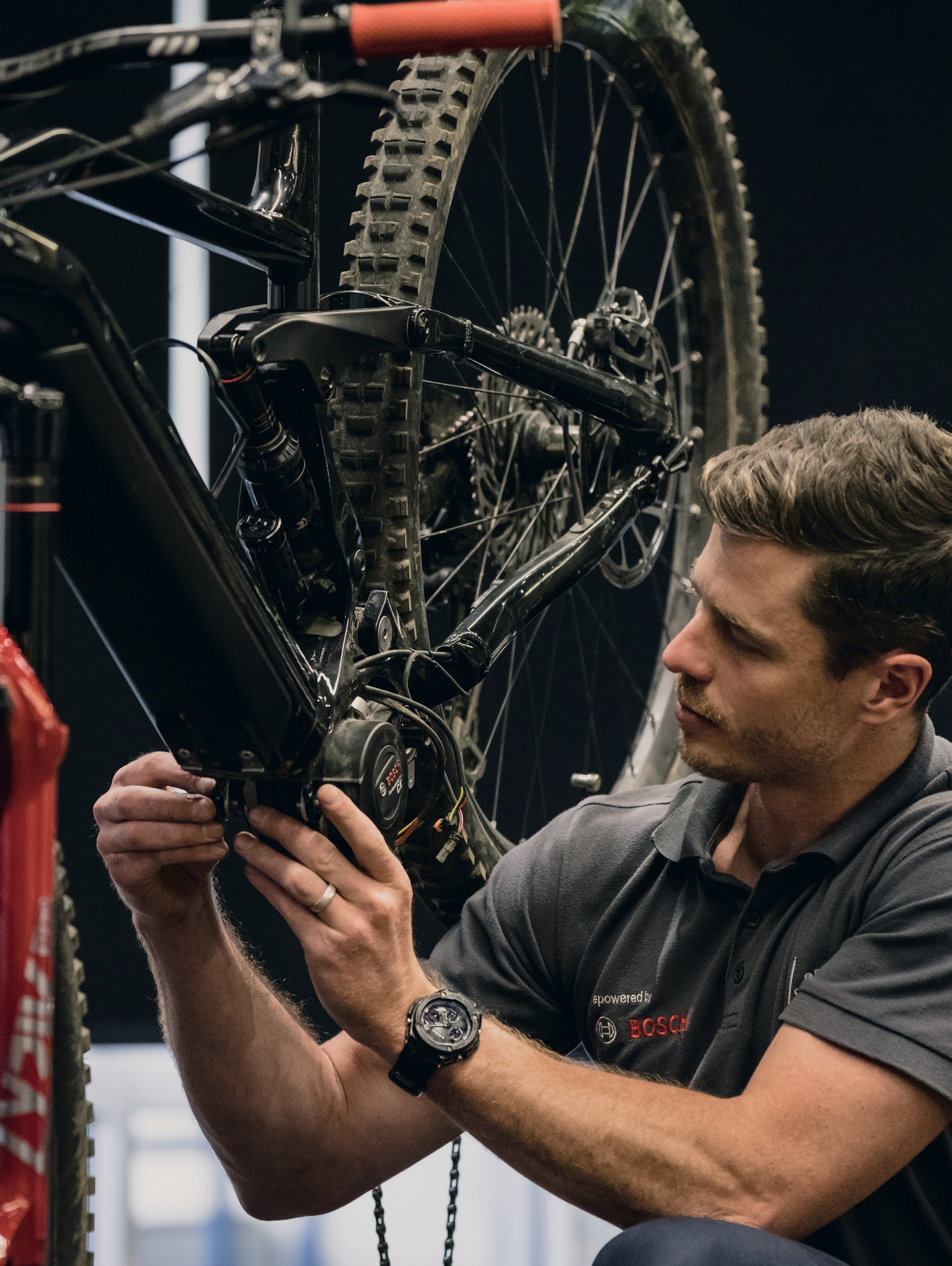
“These courses are basically an open invitation to all stores that are dealing with Bosch or maybe want to deal with Bosch in the future. We do product training, including hands-on troubleshooting and that sort of thing, for the dealers. We get them, front and centre, with any new product. Sometimes, we’ll run them through scenarios with problem components to problem-solve and find issues with components. It’s quite a full experience in that aspect. With the number of brands we have in the market now, we deal with just about every store in the country on some level. There aren’t many stores that don’t have at least some sort of Bosch powered bike in there.”
Training sessions are tailored to the NZ market and bring together the big-picture Bosch brand and history, combined with Kieran’s first-hand experiences as a rider and technical whizz. Kieran covers everything from new features and functions to how components and controllers interact with a rider, and the mechanics of how the systems work together. There’s subtle yet important information where he delves into design choices, like the how and why of the materials chosen specifically for their vibration-damping properties in a drive unit.
Kieran explains that he has a wide range of students turn up to the training; some guys who’ve been through his sessions since their inception over six years ago, bringing their own experiences and insights. There are fresh faces just starting their time in the bike industry who gain so much from the training itself, as well as from the experience of those with years of on-the-job experience.
When a consumer has an issue, be it an error code showing up on their system or something more significant, the structure in place to support the dealer is there to get the customer sorted and back riding ASAP. First and foremost, a bike mechanic will use the Bosch diagnostic tool to identify any errors. If there are no apparent errors at play, they may undertake a process of cross- swapping components to narrow down whether a damaged cable or component is the issue.
“Sometimes it’s as simple as diagnosing it on the diagnostic tool or doing some cross-swapping, say swapping in a battery out of another bike to rule out an issue there, or swapping out a cable or controller. Once they have isolated the error, they will then create a service case with us. That service case then goes into our service queue, which Marleen wholesalers handle. From there, they basically take it on. If it’s something odd or needs escalation for some reason, that’s where I’d come in and provide support from the Bosch side with Marleen’s. And then, essentially, it’s just a turnaround of, hey, it’s this particular issue, maybe this is something we know is a problem. We’ll send a replacement component out, or sometimes it’s the case that a motor will come back, and they can do testing at Marleen Wholesalers on it, so they can identify if it may be a motor issue. They’ll even put it in other test bikes, sometimes to see whether that error is still happening; there’s a lot that can go into diagnosing a problem.”
“From there, if something needs a replacement, the new part goes back to the store. All this is with the aim to get the customer back on the bike as soon as possible.”